
Daily Sabah logo

Politics
Diplomacy Legislation War On Terror EU Affairs Elections News Analysis
TÜRKİYE
Istanbul Education Investigations Minorities Expat Corner Diaspora
World
Mid-East Europe Americas Asia Pacific Africa Syrian Crisis Islamophobia
Business
Automotive Economy Energy Finance Tourism Tech Defense Transportation News Analysis
Lifestyle
Health Environment Travel Food Fashion Science Religion History Feature Expat Corner
Arts
Cinema Music Events Portrait Reviews Performing Arts
Sports
Football Basketball Motorsports Tennis
Opinion
Columns Op-Ed Reader's Corner Editorial
PHOTO GALLERY
JOBS ABOUT US RSS PRIVACY CONTACT US
© Turkuvaz Haberleşme ve Yayıncılık 2025

Daily Sabah - Latest & Breaking News from Turkey | Istanbul

  • Politics
    • Diplomacy
    • Legislation
    • War On Terror
    • EU Affairs
    • Elections
    • News Analysis
  • TÜRKİYE
    • Istanbul
    • Education
    • Investigations
    • Minorities
    • Expat Corner
    • Diaspora
  • World
    • Mid-East
    • Europe
    • Americas
    • Asia Pacific
    • Africa
    • Syrian Crisis
    • Islamophobia
  • Business
    • Automotive
    • Economy
    • Energy
    • Finance
    • Tourism
    • Tech
    • Defense
    • Transportation
    • News Analysis
  • Lifestyle
    • Health
    • Environment
    • Travel
    • Food
    • Fashion
    • Science
    • Religion
    • History
    • Feature
    • Expat Corner
  • Arts
    • Cinema
    • Music
    • Events
    • Portrait
    • Reviews
    • Performing Arts
  • Sports
    • Football
    • Basketball
    • Motorsports
    • Tennis
  • Gallery
  • Opinion
    • Columns
    • Op-Ed
    • Reader's Corner
    • Editorial
  • TV

Scientists discover 100M year-old spider fossil with tail

by

WASHINGTON Feb 06, 2018 - 12:00 am GMT+3
No Image
by Feb 06, 2018 12:00 am

If you are not a fan of spiders, you may not like the creepy little arachnid scientists found entombed in chunks of amber from northern Myanmar. Unlike its spider cousins alive today, this guy had a tail.

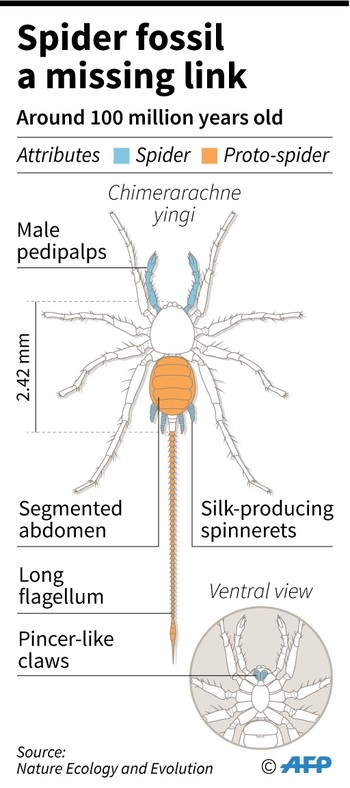
Scientists on Monday described four specimens of the arachnid, called Chimerarachne yingi, that inhabited a Cretaceous Period tropical forest about 100 million years ago during the dinosaur age. Alongside modern spider traits such as a silk-producing structure called a spinneret, it possessed a remarkably primitive feature: a whip-like tail covered in short hairs that it may have used for sensing predators and prey.
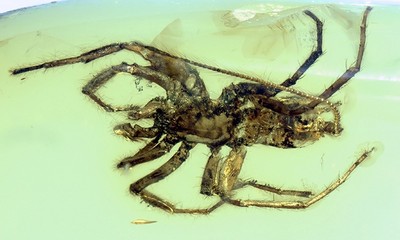
This handout image obtained via the Nature website on February 5, 2018 shows a  Photo of the paratype of a ventral view of second specimen of a Chimerachne yingi spider (AFP Photo)

"It is a key fossil for understanding spider origins," said paleontologist Bo Wang of the Chinese Academy of Sciences. "Our new fossil most likely represents the earliest branch of spiders, and implies that there was a lineage of tailed spiders that presumably originated in the Paleozoic (the geological era that ended 251 million years ago) and survived at least into the Cretaceous of Southeast Asia."

Despite its fearsome appearance, the fanged Chimerarachne was only about three-tenths of an inch (7.5 mm) long, more than half of which was its tail.

University of Kansas paleontologist Paul Selden said Chimerarachne represents "a kind of missing link" between true spiders and earlier spider forerunners that had tails but lacked spinnerets.

"Chimerarachne could be considered as a spider. It all depends on where we decide to draw the line," Selden said. "I am sure arachnophobes would not like this animal, except that it is only a few millimeters long, so it would be living almost unseen by them."

The earliest arachnids, a group including spiders, scorpions, mites, ticks and others, dates to about 420 million years ago. The oldest-known true spiders lived about 315 millions year ago.
Numerous animals and plants have been found beautifully preserved inside amber, which is fossilized tree resin. Many important amber finds have been made in Myanmar. Chimerarachne may have lived under bark or in the moss at the foot of a tree.

"All four specimens are adult males, which would have been roving around looking for females at this point in their lives," Selden said.

"Chimerarachne most likely wove a sheet web, and possibly a burrow lined with silk. Spiders use silk for a great many purposes, of which prey-capture webs is just one. Egg-wrapping is a vital function for spider silk, as well as laying a trail to find its way back home."

The research was published in the journal Nature Ecology & Evolution.

About the author
Research Associate at Center for Islam and Global Affairs (CIGA) at Istanbul Sabahattin Zaim University
  • shortlink copied
  • Last Update: Feb 06, 2018 11:40 am
    KEYWORDS
    life
    The Daily Sabah Newsletter
    Keep up to date with what’s happening in Turkey, it’s region and the world.
    You can unsubscribe at any time. By signing up you are agreeing to our Terms of Use and Privacy Policy. This site is protected by reCAPTCHA and the Google Privacy Policy and Terms of Service apply.
    No Image
    Top 2022 photos from across world
    PHOTOGALLERY
    • POLITICS
    • Diplomacy
    • Legislation
    • War On Terror
    • EU Affairs
    • News Analysis
    • TÜRKİYE
    • Istanbul
    • Education
    • Investigations
    • Minorities
    • Diaspora
    • World
    • Mid-East
    • Europe
    • Americas
    • Asia Pacific
    • Africa
    • Syrian Crisis
    • İslamophobia
    • Business
    • Automotive
    • Economy
    • Energy
    • Finance
    • Tourism
    • Tech
    • Defense
    • Transportation
    • News Analysis
    • Lifestyle
    • Health
    • Environment
    • Travel
    • Food
    • Fashion
    • Science
    • Religion
    • History
    • Feature
    • Expat Corner
    • Arts
    • Cinema
    • Music
    • Events
    • Portrait
    • Performing Arts
    • Reviews
    • Sports
    • Football
    • Basketball
    • Motorsports
    • Tennis
    • Opinion
    • Columns
    • Op-Ed
    • Reader's Corner
    • Editorial
    • Photo gallery
    • DS TV
    • Jobs
    • privacy
    • about us
    • contact us
    • RSS
    © Turkuvaz Haberleşme ve Yayıncılık 2021
