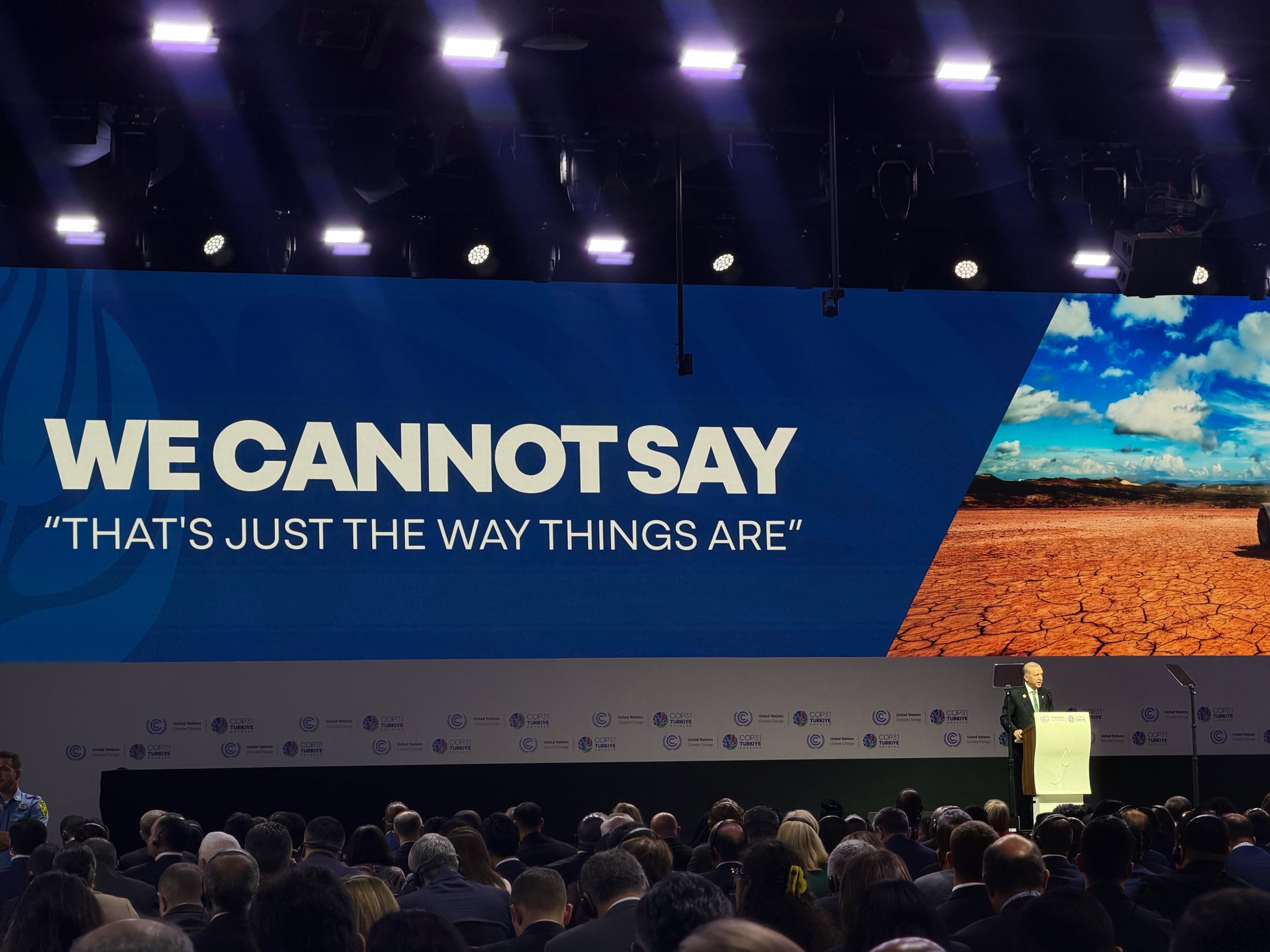
The World Leaders Climate Action Summit opened in Antalya on Wednesday as part of the 31st United Nations Climate Change Conference (COP31), bringing heads of state and government together for two days of high-level discussions on accelerating global climate action.
Speaking at the opening ceremony, President Recep Tayyip Erdoğan called for urgent action against the climate crisis, fairer climate financing and stronger international cooperation, saying Türkiye aimed to make COP31 an “implementation COP” that turns international commitments into concrete results.
“We chose to light a candle instead of punching at the darkness,” Erdoğan said, urging countries to move beyond complaints and take action to address the climate crisis.
Erdoğan said international climate negotiations had made significant progress in bringing the issue to the global agenda, but implementation remained insufficient. He warned that the risks and costs facing humanity would continue to increase as countries failed to meet the targets set out in the Paris Agreement.
“Humanity has only one roof, the sky, and one garden, the Earth,” he said, describing environmental protection as a common responsibility shared by civilizations, cultures and religions.
He warned that excessive consumption was deepening the world's environmental crisis, pointing to global warming, biodiversity loss, the depletion of natural resources and growing threats to food security. The destruction of forests, pollution of seas and loss of trees, he said, ultimately affect the entire planet.
Erdoğan said Türkiye was pursuing its 2053 net-zero emissions target while expanding renewable energy investments, clean transport and energy efficiency. Renewable energy sources now account for more than 60% of Türkiye's installed electricity capacity, he said, adding that the country had strengthened its climate policies through a climate law and a nationwide water-efficiency campaign.
He also highlighted Türkiye's Zero Waste Project, launched in 2017 under first lady Emine Erdoğan's leadership, saying it had brought 90 million tonnes of waste back into the economy.
The United Nations General Assembly's designation of March 30 as the International Day of Zero Waste, he added, demonstrated how a national initiative could become a global achievement.
Erdoğan also highlighted Türkiye’s National Afforestation Day, observed annually on Nov. 11, saying millions of seeds and saplings are planted across the country each year. He linked the initiative to Türkiye’s broader environmental efforts, emphasizing the importance of protecting forests and natural resources for future generations.
Under COP31's Action Agenda, Türkiye aims to advance implementation across 10 priority areas, including clean energy, zero waste, food security, industrial transformation, climate-resilient cities and ocean protection. Erdoğan said the presidency was seeking to halve the projected increase in waste generation and expand circular-material use in industry.
On climate finance, Erdoğan said developing countries and small island states needed easier access to funding, technology and capacity-building opportunities, particularly because countries that have contributed least to climate change often face its most severe consequences.
He called on developed countries to assume greater responsibility for emissions reductions and climate financing, stressing that support must be more accessible, predictable and responsive to the needs of vulnerable nations. The right of developing countries to pursue economic development, he added, must also be protected.
Erdoğan pointed to Türkiye's Climate Implementation Bridge initiative, announced in September, as a way to connect local needs with concrete investments. He also emphasized the importance of giving vulnerable Pacific island nations a stronger voice in global climate discussions, noting that preparations for COP31 had included meetings in Fiji and Tuvalu.
He urged countries to increase international awareness of drought, soil degradation and extreme weather, which threaten farmers' livelihoods and millions of people's access to healthy food. Building more resilient urban infrastructure, improving energy efficiency in buildings and ensuring that local governments can access financing would also be critical, he said.
Erdoğan also addressed the environmental consequences of the war in Gaza, saying armed conflicts cause profound damage to both people and nature.
“In Gaza, there has been not only genocide but also environmental destruction,” he said, citing the destruction of olive trees, pollution of soil and water, and cities reduced to rubble.
He highlighted the plight of displaced Palestinians whose tents have been flooded by heavy rainfall, saying many families, including children, were struggling to survive in harsh winter conditions. Erdoğan called for restrictions on humanitarian assistance to end and urged that container shelters be allowed into Gaza.
Meanwhile, U.N. Secretary-General Antonio Guterres warned that the climate crisis was accelerating beyond the world’s response as greenhouse gas emissions, rising temperatures and climate-driven disasters intensified.
“The brutal truth is that the climate crisis is outrunning us. This is the path to mutually assured destruction,” he said.
“But science is not telling us to surrender. It is telling us to fight harder,” Guterres added, urging countries to accelerate the transition to clean energy. “Fossil fuels must go the way of the dinosaurs.”
Ethiopian President Taye Atske Selassie highlighted his country’s efforts to restore degraded land, expand renewable energy and strengthen early-warning systems, while calling for greater international support for vulnerable communities.
He pointed to Ethiopia’s Green Legacy Initiative, which has planted more than 50 billion seedlings, and called for climate finance to reach developing nations in time to support adaptation and resilience. He also stressed the importance of preparing communities for extreme weather before disasters strike.
Australian Prime Minister Anthony Albanese called for stronger international cooperation, highlighting the threats facing vulnerable Pacific island nations from rising sea levels and extreme weather.
“COP31 must be where our cooperation delivers practical results,” Albanese said, calling for greater investment in clean energy, electrification and climate finance.
Recalling a meeting with a 13-year-old student from Tuvalu who fears for her future because of climate change, he quoted her appeal to world leaders: “We are not asking for pity. We are asking for help and partnership.”
Albanese also highlighted Australia’s renewable energy progress, saying renewables now account for half of the country’s electricity mix. He stressed that vulnerable countries need greater financial support to adapt to climate impacts, saying “the most vulnerable countries need capital.”
Held under the theme “Towards a Sustainable, Resilient and Equitable Future,” the two-day summit focuses on climate implementation, the energy transition, financing and resilience. Wednesday’s programme also coincides with COP31’s zero waste theme, with a high-level roundtable focusing on circularity and methane reduction.