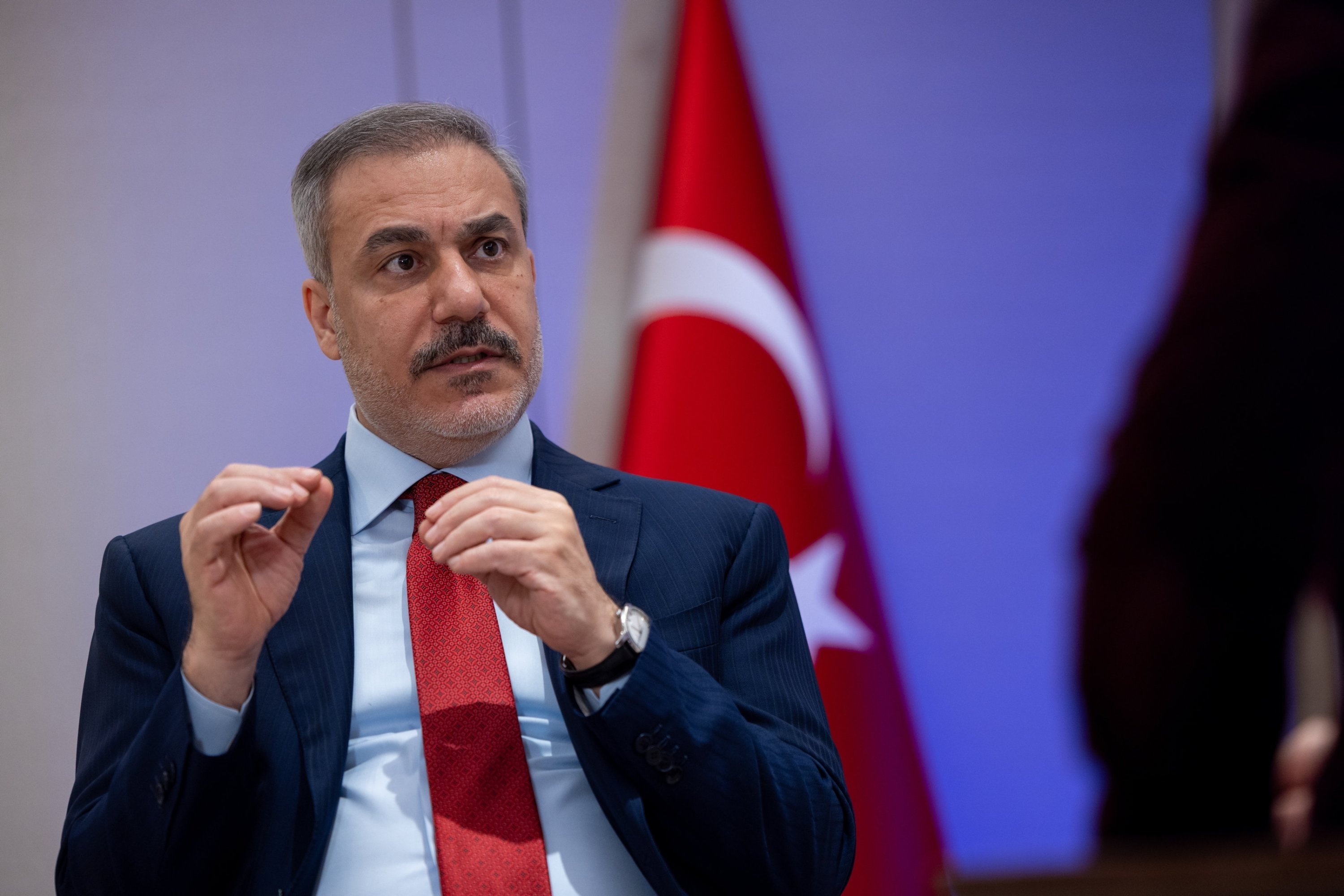
Türkiye's 2019 maritime boundary agreement with Libya is legally and politically legitimate and not open to debate, Foreign Minister Hakan Fidan said Wednesday, hailing its acceptance by Libya's House of Representatives as a major diplomatic victory for Ankara.
Speaking to Anadolu Agency (AA) during a visit to Brussels, Fidan said the development vindicated Türkiye's longstanding position on the agreement, which defines maritime jurisdiction areas between the two Mediterranean countries.
"This is an entirely legitimate agreement, both legally and politically. There is no need to debate it," Fidan said, dismissing objections from countries opposed to the deal.
Fidan described the Libyan parliament's move as a diplomatic achievement under President Recep Tayyip Erdoğan's leadership, emphasizing that the agreement promotes regional stability and mutually beneficial cooperation.
He said Ankara had considered the memorandum valid since its signing in 2019, noting that Turkish legal experts viewed the Libyan legislature's latest decision as an act of acceptance rather than formal ratification.
"We know why certain countries object. Some oppose it because they feel compelled to, while others have genuine strategic concerns," he said.
Fidan stressed that Libya's trust in Türkiye and the agreement's contribution to stability in the Eastern Mediterranean were particularly significant.
"Our goal is to bring stability, peace and prosperity to the Mediterranean, just as we seek to do everywhere else," he added.
During his Brussels visit, Fidan also held talks with NATO Secretary-General Mark Rutte, European Commission President Ursula von der Leyen and EU foreign policy chief Kaja Kallas, discussing Türkiye-EU relations, regional security and the Russia-Ukraine war.
He also joined Türkiye's justice and interior ministers for talks with their Belgian counterparts aimed at strengthening bilateral cooperation.
Fidan called for sustained engagement with the EU to overcome longstanding obstacles in relations, including issues surrounding Türkiye's candidate status.
Libya's House of Representatives announced Tuesday that it unanimously approved the agreement, reversing its previous rejection of the deal and a decision to sever political ties with Ankara, according to a statement from the Libyan Parliament.
The Parliament also repealed Resolution No. 1 of 2020, which rejected the ratification of two memorandums of understanding signed between Libya and Türkiye. Lawmakers additionally voted unanimously to overturn Resolution No. 6 of 2020, which called for severing political relations with Ankara, the statement said.
The agreement confirms Türkiye’s maritime jurisdiction across the vast Mediterranean and will likely anger Greece, which competes with Türkiye for economic benefits and more maritime rights. The agreement also cements Türkiye’s clout in the Eastern Mediterranean, where Greek Cypriots, Greece and Israel recently stepped up cooperation. The deal was registered by the U.N. in October 2020, but the disagreement between Tobruk-based and Tripoli-based powers prevented the implementation of the delimitation deal. Greece has lobbied Khalifa Haftar against the agreement, claiming that it would infringe its own rights in the Mediterranean maritime zone.
The deal includes provisions for Turkish hydrocarbon exploration within Libya’s territorial waters. In 2022, the two countries signed a hydrocarbon memorandum of understanding, paving the way for Turkish companies to conduct seismic surveys and drilling operations. The agreement took a new turn on June 25, 2025, when the Turkish Petroleum Corporation (TPAO) signed a memorandum of understanding with Libya’s National Oil Corporation (NOC) for a 2D seismic survey in the Libyan waters. Under the memorandum, the TPAO will conduct surveys in four offshore blocks off the Libyan coast, over an area covering 10,000 kilometers (6,214 miles). The data collected during the surveys will be processed within nine months.