Daily Sabah logo

Politics
Diplomacy Legislation War On Terror EU Affairs Elections News Analysis
TÜRKİYE
Istanbul Education Investigations Minorities Expat Corner Diaspora
World
Mid-East Europe Americas Asia Pacific Africa Syrian Crisis Islamophobia
Business
Automotive Economy Energy Finance Tourism Tech Defense Transportation News Analysis
Lifestyle
Health Environment Travel Food Fashion Science Religion History Feature Expat Corner
Arts
Cinema Music Events Portrait Reviews Performing Arts
Sports
Football Basketball Motorsports Tennis
Opinion
Columns Op-Ed Reader's Corner Editorial
PHOTO GALLERY
JOBS ABOUT US RSS PRIVACY CONTACT US
© Turkuvaz Haberleşme ve Yayıncılık 2025

Daily Sabah - Latest & Breaking News from Turkey | Istanbul

  • Politics
    • Diplomacy
    • Legislation
    • War On Terror
    • EU Affairs
    • Elections
    • News Analysis
  • TÜRKİYE
    • Istanbul
    • Education
    • Investigations
    • Minorities
    • Expat Corner
    • Diaspora
  • World
    • Mid-East
    • Europe
    • Americas
    • Asia Pacific
    • Africa
    • Syrian Crisis
    • Islamophobia
  • Business
    • Automotive
    • Economy
    • Energy
    • Finance
    • Tourism
    • Tech
    • Defense
    • Transportation
    • News Analysis
  • Lifestyle
    • Health
    • Environment
    • Travel
    • Food
    • Fashion
    • Science
    • Religion
    • History
    • Feature
    • Expat Corner
  • Arts
    • Cinema
    • Music
    • Events
    • Portrait
    • Reviews
    • Performing Arts
  • Sports
    • Football
    • Basketball
    • Motorsports
    • Tennis
  • Gallery
  • Opinion
    • Columns
    • Op-Ed
    • Reader's Corner
    • Editorial
  • TV
  • Life
  • Health
  • Environment
  • Travel
  • Food
  • Fashion
  • Science
  • Religion
  • History
  • Feature
  • Expat Corner

Webb rewrites understanding of early universe with massive galaxies

by Reuters

WASHINGTON Feb 23, 2023 - 11:03 am GMT+3
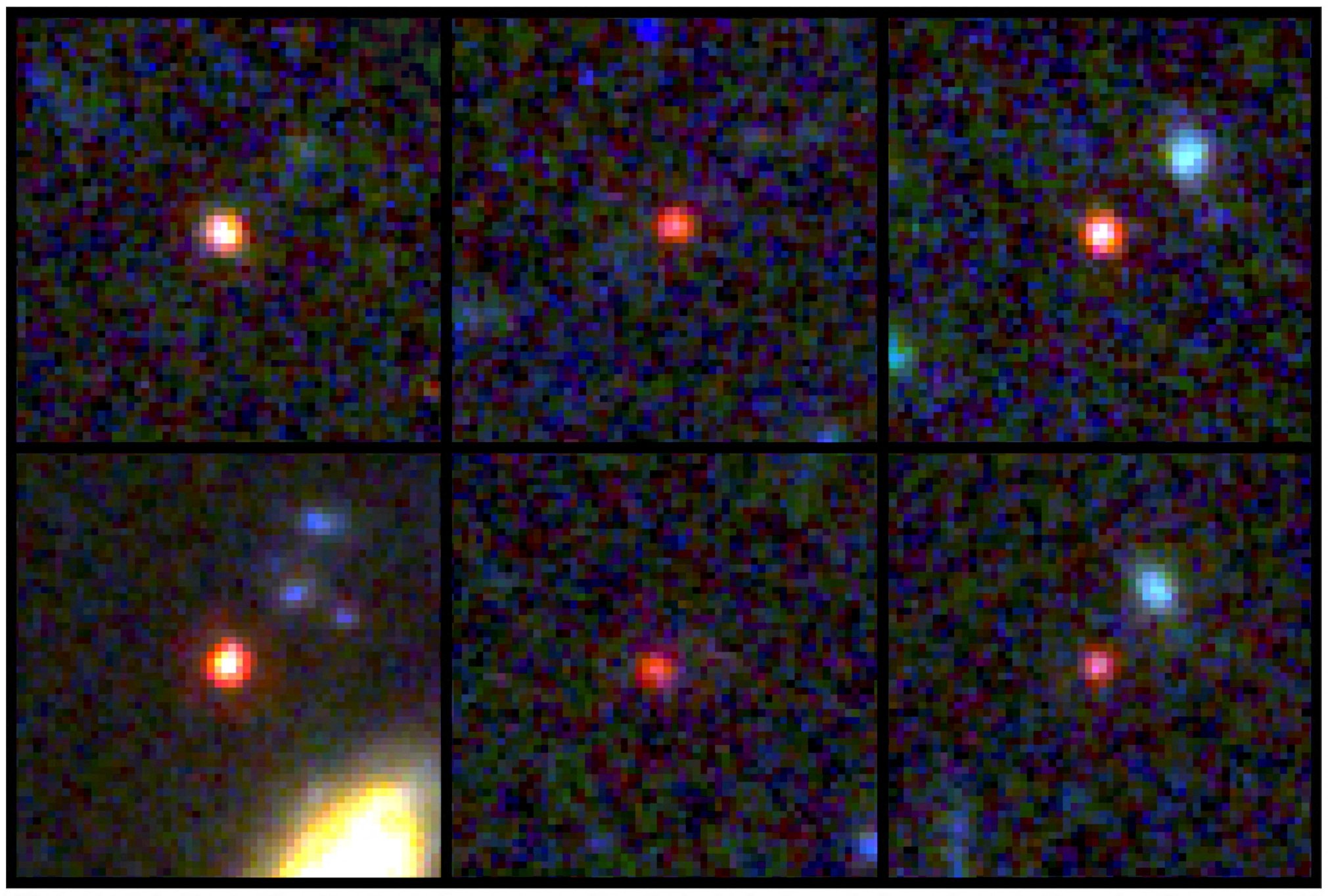
Images of six massive candidate galaxies, seen 540 million to 770 million years after the Big Bang, Outer Space. (Reuters Photo)
by Reuters Feb 23, 2023 11:03 am

Our understanding of the universe, and its beginnings, might be utterly wrong as astronomers – through observations by NASA's James Webb Space Telescope – have discovered six massive galaxies teeming with stars that emerged not long after the Big Bang, far sooner than scientists had considered possible.

Astronomers said data obtained by the telescope reveals what appear to be six giant galaxies as mature as our Milky Way, existing about 540 million to 770 million years after the explosive Big Bang that kicked off the universe 13.8 billion years ago. The universe was roughly 3% of its current age at the time.

These galaxies, one of which appears to have a mass rivaling our Milky Way but 30 times more densely packed, seem to differ in fundamental ways from those populating the universe today.

"Oh, they are radically different – truly bizarre creatures," said astrophysicist Ivo Labbe of Swinburne University of Technology in Australia, lead author of the study published in Nature. "If the Milky Way were a regular-sized average adult, say about 5'9" (1.75 meters) and 160 pounds (70 kilograms), these would be 1-year-old babies weighing about the same but standing just under 3 inches (7 centimeters) tall. The early universe is a freak show."

Webb was launched in 2021 and began collecting data last year. The findings were based upon the first dataset released by NASA last July from Webb, a telescope boasting infrared-sensing instruments able to detect light from the most ancient stars and galaxies.

"This is an astounding discovery and unexpected. We thought that galaxies form over much longer periods," said Penn State astrophysicist and study co-author Joel Leja. "No one expected to find these. These galaxy candidates are too evolved for our expectations. They seem to have evolved faster than allowed by our standard models."

Leja called them galaxy candidates because further observations are needed to confirm that they all are galaxies rather than some other light source like a supermassive black hole.

"The exciting part is that even if only some turn out to be massive galaxies, these things are so massive that they alone would upend our measurements of the total mass in stars at this time. It would suggest 10 to 100 times more mass in stars existing at this epoch than expected and imply that galaxies form way faster in the universe than anyone thought."

The galaxies appear to contain the mass equivalent to 10 billion to 100 billion times that of our sun. The latter figure is similar to the Milky Way's mass.

The journey to galaxy formation following the Big Bang hinged on mysterious material called dark matter that is invisible to us but is known to exist because of the gravitational influence it exerts on ordinary matter.

"The leading theory is that an ocean of dark matter filled the early universe after the Big Bang," Labbe said.

"This dark matter – we don't know what it is – started smooth, with only the tiniest ripples. These ripples grew over time due to gravity, and eventually, the dark matter started to collect in concentrated clumps, dragging hydrogen gas along for the ride. It's that hydrogen gas that will eventually turn into stars. Clumps of dark matter, gas and stars is what we call a galaxy," Labbe added.

Astronomers suspect the first stars began forming 100 million to 200 million years after the Big Bang, each perhaps 1,000 more massive than our sun but much shorter-lived.

"Their explosion set off the chain of events that formed subsequent generations of stars," Labbe said.

"Webb continues to amaze and surprise us," Labbe added. "So yes, the early universe was a lot richer and a lot more diverse – monsters and dragons. And the curtain is still being lifted."


  • shortlink copied
  • Last Update: Feb 23, 2023 1:27 pm
    KEYWORDS
    universe big bang galaxies space james webb space telescope
    The Daily Sabah Newsletter
    Keep up to date with what’s happening in Turkey, it’s region and the world.
    You can unsubscribe at any time. By signing up you are agreeing to our Terms of Use and Privacy Policy. This site is protected by reCAPTCHA and the Google Privacy Policy and Terms of Service apply.
    No Image
    In photos: A look into Prince Philip's lifetime
    PHOTOGALLERY
    • POLITICS
    • Diplomacy
    • Legislation
    • War On Terror
    • EU Affairs
    • News Analysis
    • TÜRKİYE
    • Istanbul
    • Education
    • Investigations
    • Minorities
    • Diaspora
    • World
    • Mid-East
    • Europe
    • Americas
    • Asia Pacific
    • Africa
    • Syrian Crisis
    • İslamophobia
    • Business
    • Automotive
    • Economy
    • Energy
    • Finance
    • Tourism
    • Tech
    • Defense
    • Transportation
    • News Analysis
    • Lifestyle
    • Health
    • Environment
    • Travel
    • Food
    • Fashion
    • Science
    • Religion
    • History
    • Feature
    • Expat Corner
    • Arts
    • Cinema
    • Music
    • Events
    • Portrait
    • Performing Arts
    • Reviews
    • Sports
    • Football
    • Basketball
    • Motorsports
    • Tennis
    • Opinion
    • Columns
    • Op-Ed
    • Reader's Corner
    • Editorial
    • Photo gallery
    • DS TV
    • Jobs
    • privacy
    • about us
    • contact us
    • RSS
    © Turkuvaz Haberleşme ve Yayıncılık 2021