Scientists have discovered a remarkable find of fossilized remnants of a crucial element of cell membranes in ancient rocks, dating back approximately 1.6 billion years, which provides a glimpse into a fascinating era known as the "lost world," where microscopic organisms thrived.
These remains, researchers said on Wednesday, date to a time span during what is called the Proterozoic Eon that was crucial in the evolution of complex life but has been shrouded in mystery because of a spotty fossil record of the microscopic organisms that inhabited Earth's marine realm.
The newly identified fossils are of a rudimentary form of a steroid – a fat molecule that was an indispensable ingredient in cell membranes of pioneering members of a domain of now-dominant organisms called eukaryotes (pronounced yoo-KAR-ee-oats). Eukaryotes possess a complex cell structure including a nucleus that acts as a command and control center and subcellular structures called mitochondria that power the cell.
They were gate-crashers in a world teeming with bacteria, simpler unicellular organisms lacking a nucleus. Eukaryotes today include fungi, algae, plants and animals, but none of those had yet evolved.
The newly described fossils do not include the actual body of the organisms but rather their molecular remnants, leaving unclear their size, appearance, behavior and complexity – including whether they were all unicellular or some were multicellular. "We have no clue," said geobiologist Jochen Brocks of the Australian National University in Canberra, lead author of the study published in the journal Nature.
The researchers suspect they were not meek.
"Despite their mostly small size, they might already have included fierce predators that preyed on smaller bacteria or maybe even other eukaryotes," said geobiologist and study co-author Benjamin Nettersheim of the University of Bremen in Germany.
There are some "body" fossils of primitive eukaryotes dating back more than 1.6 billion years, but their scarcity compared to the plentiful bacterial remains from that time had suggested they were bit players in a larger drama. The researchers discovered that the molecular fossils indicating the presence of these primitive eukaryotes were commonplace in rocks spanning from about 1.6 billion years ago to 800 million years ago.
"It is a lost world in the sense that we had not been able to see or detect them – although there was an entire world of them. They were not rare and lasted for hundreds of millions of years," Brocks said.
It is a lost world also because these forms are now entirely extinct, Brocks added. Their disappearance paved the way for modern eukaryotic forms to spread around 800 million years ago.
When the primitive eukaryotes existed, Earth's land expanses were barren rock, while large parts of the seafloor were blanketed in thick microbial mats and ocean waters experienced incursions of toxic hydrogen sulfide gas smelling like rotten eggs.
Until now, those oceans were thought to have been largely a bacterial broth, with eukaryotes rare or restricted to marginal habitats such as shorelines or rivers. The fossil steroid molecules found entrapped in sedimentary rocks deposited on ancient seafloors instead reveal eukaryotes to have been surprisingly abundant.
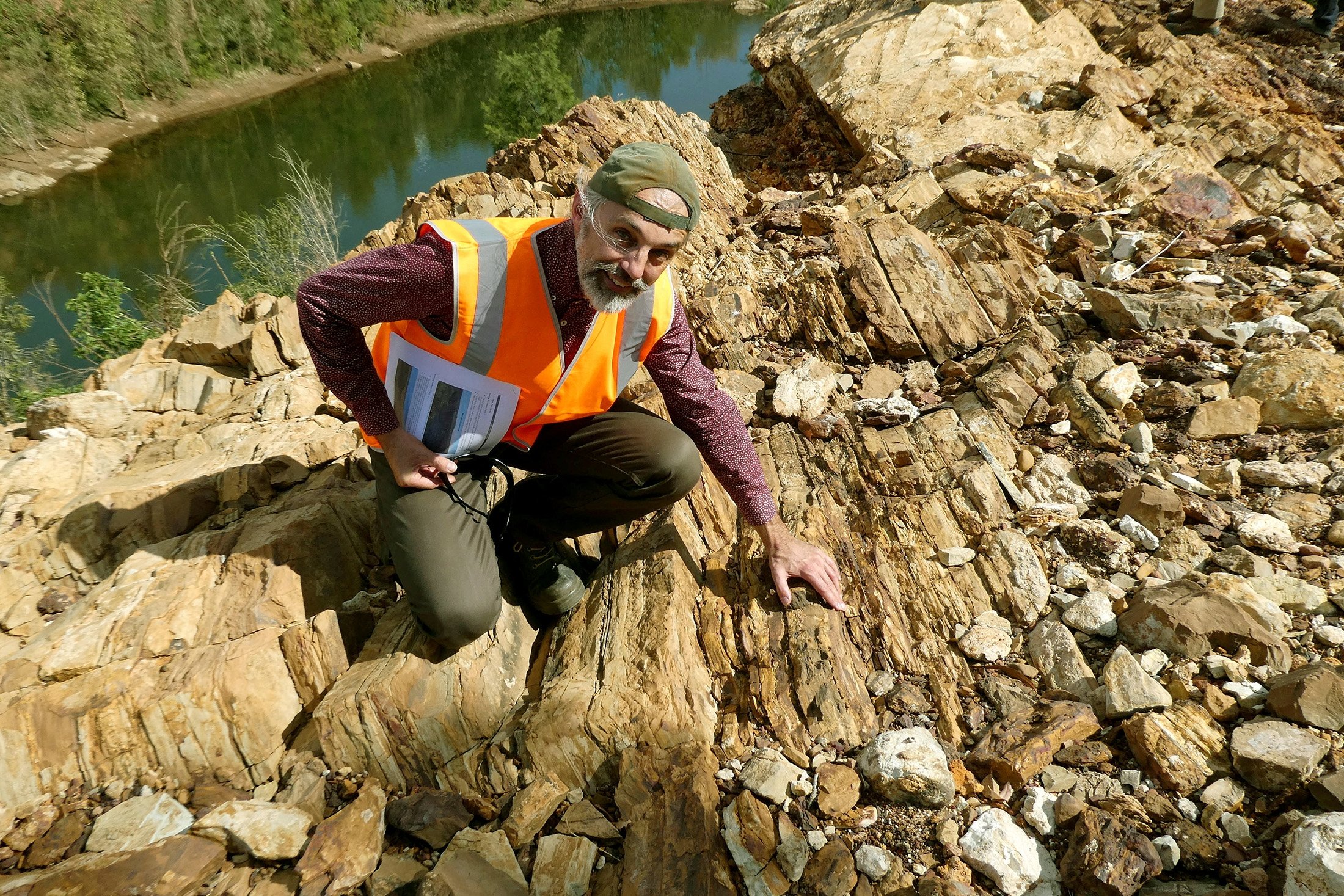
The oldest of the rocks bearing these fossils were unearthed in the remote Outback of northern Australia, near Darwin.
Scientists long were puzzled about the seeming absence of molecular fossils from this time span indicative of primitive eukaryotes. It turns out they had been searching for steroids more biologically advanced than these organisms possessed.
Biochemist Konrad Block, who won a Nobel Prize in 1964 and died in 2000, had hypothesized that primordial eukaryotes produced such primitive steroids but doubted they would ever be discovered.
"I wish I could tell him that we found them," Brocks said.