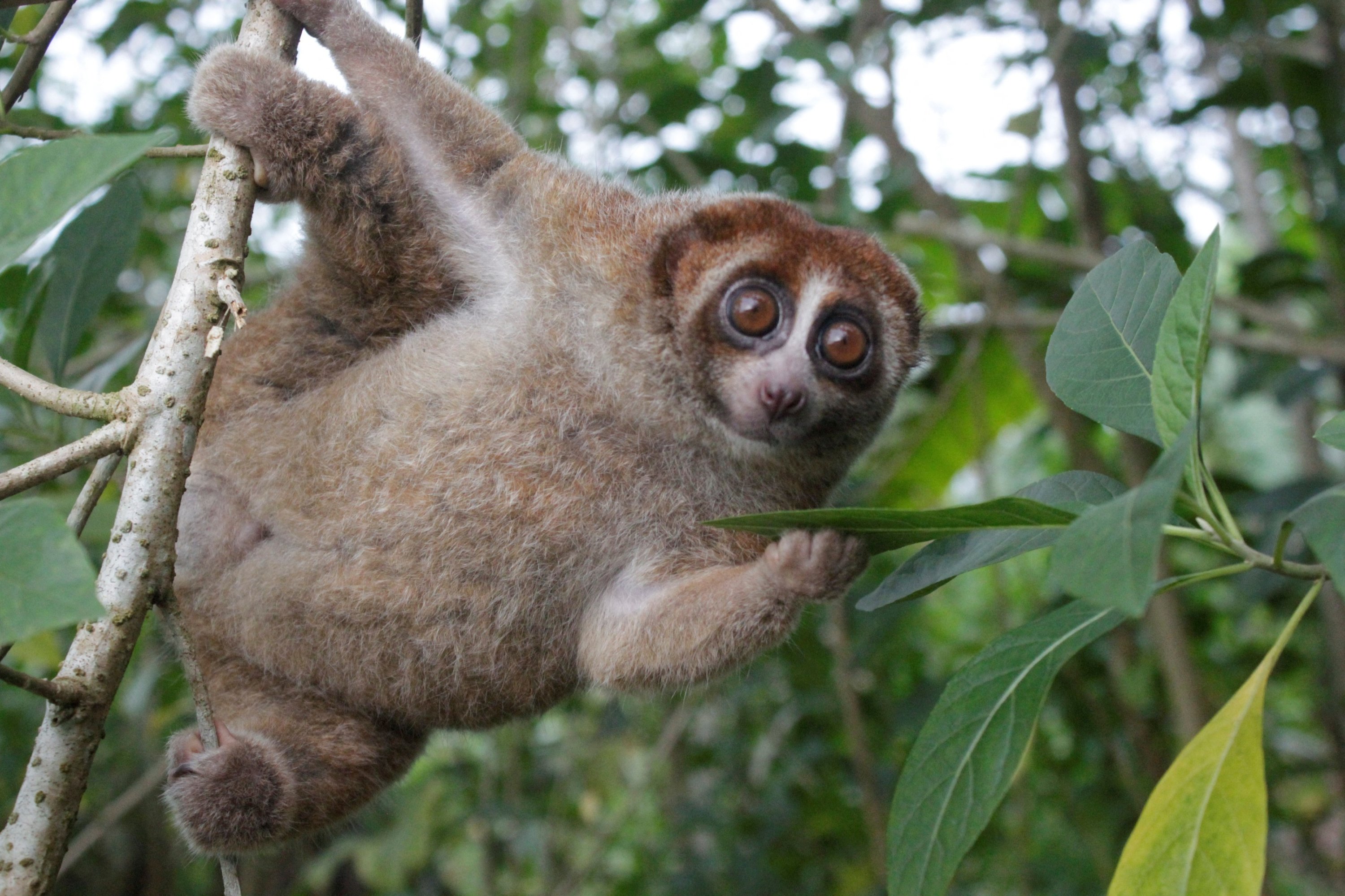
The Bangka slow loris is one of Earth's most exotic primates, a slow-moving tree dweller that happens to be venomous. It was listed as critically endangered and possibly extinct, last scientifically documented in the 1930s, but now has been rediscovered on the tropical Indonesian island of Bangka.
Scientists revealed in a new study that an animal rescue organization came across more than 90 Bangka slow loris individuals in recent years on Bangka, located off the southeastern coast of Sumatra. Most were returned to the wild.
"The Bangka slow loris is still alive," said Timon Glaw, a graduate student in nature conservation and biodiversity management at the Haus des Meeres Aqua Terra Zoo in Vienna, Austria, and one of the authors of the study published in the journal Spixiana.
The rescued animals came from different parts of Bangka, showing the species has survived in several areas despite extensive habitat destruction and decades of scientific neglect, Glaw said. Its habitat has been diminished due to tin mining and land clearing for oil palm plantations, Glaw said.
"What I find particularly astonishing is that such a charismatic and distinctive primate has received so little scientific attention for nearly a century. Its rediscovery also offers hope that other species feared to be extinct may still survive in places where scientists have not looked for decades," Glaw said. "After all, Bangka is just about an hour flight from Jakarta, one of the largest cities in the world."
The Bangka slow loris, whose scientific name is Nycticebus bancanus, is a relatively small, nocturnal primate, with reddish-brown fur, distinctive facial markings and large eyes. It moves slowly and deliberately in the trees, unlike other arboreal primates such as apes, monkeys and lemurs that can move quickly across branches.
In the primate evolutionary lineage, the Bangka slow loris is more closely related to the lemurs of Madagascar and the galagos of Africa than to monkeys or apes - or people.
"The last historical scientific records from Bangka discussed in our study date back to the early 1930s, more precisely to the period between 1930 and 1932. For decades, there was no reliable information on whether the species survived on the island," Glaw said.
In 2020, the International Union for Conservation of Nature, the organization that monitors the status of species, deemed the Bangka slow loris critically endangered and possibly extinct. The species also was listed as one of the "lost primates" by the conservation group Re:wild.
Like the world's other slow loris species, it is venomous – a rare trait among mammals. Slow lorises produce a secretion from specialized glands near their elbows, which they mix with saliva by raising their arms when threatened and then licking the glands before delivering the venom through a bite.
"The venom can cause severe allergic reactions in humans, potentially even life-threatening ones. Research on other slow loris species suggests that the venom is used primarily in conflicts with other lorises, although it may also serve defensive functions against predators and parasites," Glaw said.
Its diet is not well understood, but it likely feeds on insects, tree gums, nectar and other plant parts like other slow loris species, Glaw said.
It possesses a toothcomb formed by forward-projecting lower teeth, used mainly for grooming, gouging of tree bark for gum and delivering the venom during bites. It also has a specialized second tongue beneath the main tongue that helps clean the toothcomb.
Between 2015 and 2025, the Indonesian conservation organization Alobi Wildlife Rescue Center documented more than 90 Bangka slow lorises from different localities across the island, Glaw said.
Many were rescued from houses, gardens, plantations or roads, while others suffered severe injuries, particularly from electrical wires, with a few dying despite treatment, Glaw said. Following their recovery, 86 of them were released into suitable natural habitats, Glaw said.
"The most urgent priority is to protect the remaining natural forests on Bangka from further destruction, particularly through tin mining and the expansion of oil palm plantations. We also need systematic field surveys to determine where the species still survives and how large its populations are," Glaw said.
"Every species is the result of millions of years of evolution and part of a complex ecological network, and losing the Bangka slow loris would mean losing something truly irreplaceable," Glaw said.