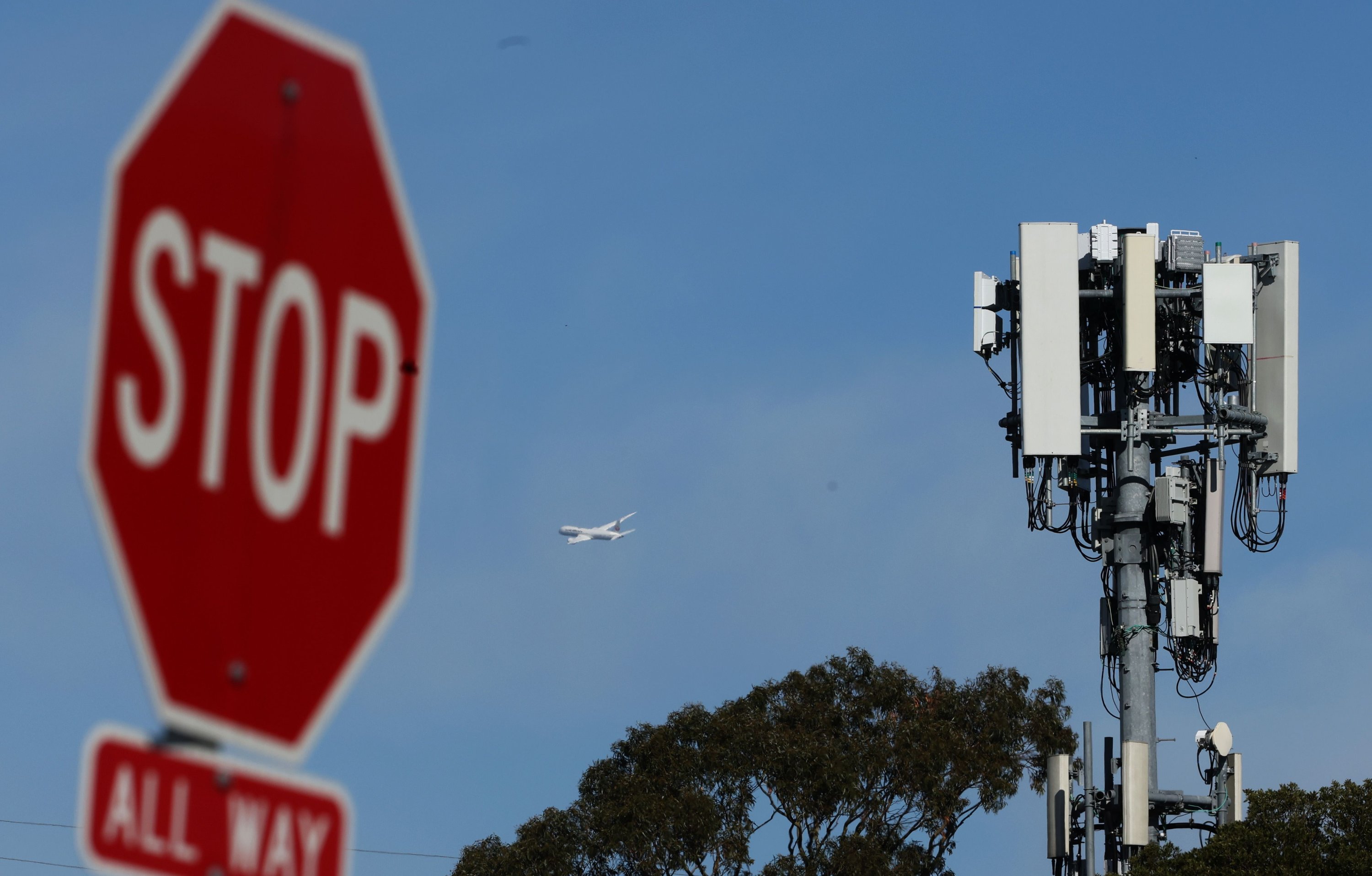
Major passenger and cargo carriers rushed to warn of impending "catastrophic" aviation crises and rejigged or canceled their flights to the United States ahead of 5G wireless rollout on Wednesday despite wireless carriers saying they will delay parts of the deployment. So, what exactly happened and do these concerns carry water?
The Federal Aviation Administration (FAA) had warned that potential 5G interference could affect altitude readings on some jets, with airlines citing the Boeing 777 among the models in the spotlight.
Despite an announcement by AT&T and Verizon that they would pause the 5G rollout near airports, several airlines still canceled flights or switched aircraft models.
Here is the background to the dispute.
The United States auctioned mid-range 5G bandwidth to mobile phone companies in early 2021 in the 3.7-3.98 GHz range on the spectrum known as C band, for about $80 billion.
The FAA warned that the new 5G technology could interfere with instruments such as altimeters, which measure how far above the ground an airplane is traveling.
Altimeters operate in the 4.2-4.4 GHz range and the concern is that the auctioned frequencies sit too close to this range.
United Airlines CEO Scott Kirby said last month the FAA's 5G directives would bar the use of radio altimeters at about 40 of the biggest U.S. airports.
U.S. airlines have warned the directives could disrupt up to 4% of daily flights.
Kirby said if left unresolved it could mean that at major U.S. airports in the event of bad weather, cloud cover or even heavy smog "you could only do visual approaches essentially."
Airlines announced plans to switch away from Boeing 777 and Boeing 747-8 aircraft, including Emirates, All Nippon Airways (ANA), Japan Airlines and Lufthansa.
In the short-term, AT&T and Verizon agreed to temporarily defer turning on some wireless towers near key airports to avert a significant disruption to U.S. flights.
Longer-term, the FAA needs to clear and allow the vast majority of the U.S. commercial airplane fleet to perform low-visibility landings at many airports where 5G C-band will be deployed. This means certifying altimeters to operate near 5G base stations.
The higher the frequency in the spectrum, the faster the service. So in order to get full value from 5G, operators want to operate at higher frequencies.
Some of the C band spectrum auctioned had been used for satellite radio but the transition to 5G means there will be much more traffic.
Verizon and AT&T have argued that C band 5G has been deployed in about 40 other countries without aviation interference issues.
They have agreed to buffer zones around 50 airports in the United States, similar to those used in France, for six months to reduce interference risks.
The European Union in 2019 set standards for mid-range 5G frequencies in a 3.4-3.8 GHz range, a lower frequency than the service set to be rolled out in the United States. The bandwidth has been auctioned in Europe and is in use in many of the bloc's 27 member states so far without issue.
The European Union Aviation Safety Agency (EASA), which oversees 31 states, said on Dec. 17 the issue was specific to U.S. airspace. "At this stage, no risk of unsafe interference has been identified in Europe," it said.
FAA officials have noted the spectrum used by France (3.6-3.8 GHz) sits further away from the spectrum (4.2-4.4 GHz) used for altimeters in the United States and France's power level for 5G is much lower than what is authorized in the United States.
Verizon has said it will not use spectrum that is closer to the higher band for several years.
In South Korea, the 5G mobile communication frequency is 3.42-3.7 GHz band and there has been no report of interference with radio wave since commercialization of 5G in April 2019.
Currently, 5G mobile communication wireless stations are in operation near airports, but there have been no reports of problems.
"Wireless carriers in nearly 40 countries throughout Europe and Asia now use the C band for 5G, with no reported effects on radio altimeters that operate in the same internationally designated 4.2-4.4 GHz band," CTIA, a U.S. wireless trade group, said in a filing with the Federal Communications Commission.